
Why You're Cooling the Wrong Thing When You Sleep
Your bedroom thermostat cannot fix the 35-degree heat pocket trapped between your body and your mattress. Learn what actually drives cooler, deeper sleep.
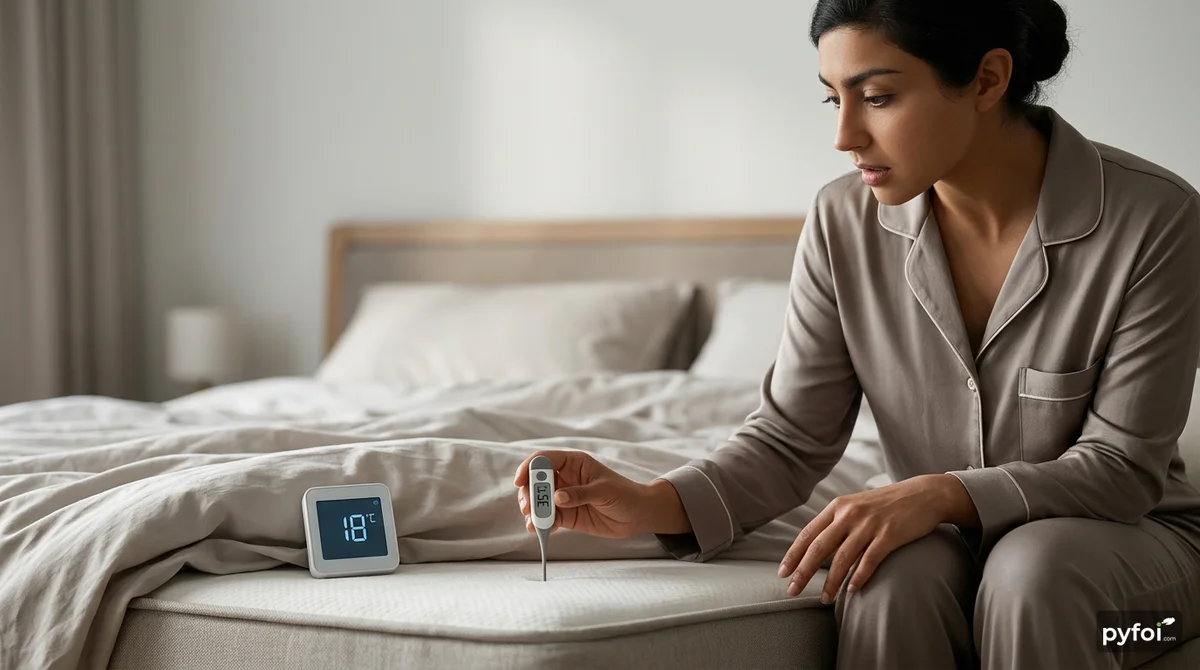
What if you could set every condition perfectly and still get it wrong? Say you have dialled the thermostat to 18 degrees, swapped to lightweight sheets, and left a fan running. Yet at 2am you are wide awake, shoulders damp. The problem is not your room. It is the few centimetres between your body and your mattress, a trapped heat pocket no air conditioner can touch.
What if the room temperature advice is only half the story?
Every sleep guide repeats the same line: keep your bedroom between 16 and 19 degrees. Good advice for the air around you. But it misses a separate thermal system right underneath you.
Your mattress surface builds its own climate. Researchers call it the bed microclimate, and it operates independently from room air temperature [1]. Dense foam absorbs body heat and, lacking airflow channels, holds it against your skin. Think of climbing into a sleeping bag inside a walk-in fridge. The fridge air is cold, but the bag traps warmth against you within minutes. Your mattress does the same, except you never realise you have zipped yourself in.
This flips the questions worth asking. How much heat does my mattress trap? How long before the surface matches my body temperature? Does it move heat away, or just soak it up?
What is your mattress doing with your body heat?
The case for treating your mattress as its own climate zone is strong:
- Auckland University tested a standard mattress and found its surface hit 35 degrees and stayed there for over 22 hours, even in a cool room [6]. Your body loses its main route for shedding heat downward.
- Research in Building and Environment confirms the bed microclimate is functionally independent of room air temperature. The optimal skin-contact range sits between 31 and 35 degrees; beyond that, sleep architecture falls apart [1].
- Memory foam, the dominant comfort material in New Zealand and Australia, is poor at releasing heat. High-density foam attracts at least twice as many heat complaints as low-density alternatives [5].
- A 2024 study in Scientific Reports (72 subjects, three centres) found deeper sleep depended not on room temperature but on how effectively heat transferred through the mattress. Subjects on high-heat-capacity mattresses gained 7.5 extra minutes of deep sleep and saw heart rate fall by 2.36 bpm [3].
Your body needs to shed heat downward to sustain the core temperature drop required for deep sleep [4]. Once the mattress matches your skin temperature, that pathway closes.

What does this feel like at 3am?
Picture this: you have spent real money on a heat pump running overnight. The duvet is gone. Your lower back sticks to the sheet, shoulders clammy, every position wrong. You decide you are "just a hot sleeper" and drag yourself into another foggy morning.
That frustration goes beyond discomfort. Broken sleep wears down patience, focus, and mood. If you share a bed with someone who sleeps fine while you overheat, it builds resentment. You have tried every fix. None worked. And the real cause, a 35-degree heat pocket beneath you, was never a suspect.
What should you actually be looking for?
Rather than spending more on room-level cooling, shift attention to the surface you lie on. Three questions cut through the noise:

- Ask about thermal performance, not just firmness. Most mattress conversations cover support, feel, and price. Add surface heat management. Ask: "How does this handle body heat over a full night?"
- Understand the foam density trade-off. Denser foam often feels more supportive but traps more heat. Know where your mattress sits on that scale.
- Look for active thermal regulation, not breathability alone. Airflow helps with moisture, but conductive heat loss at the surface is the mechanism linked to deeper sleep [3]. A mattress that pulls heat from your skin solves a different problem than one with ventilation holes.
How do you fix the heat problem in your bed?
Accept that room cooling and mattress cooling are separate jobs. Your heat pump handles one. Your mattress handles the other.
When shopping, prioritise materials that manage heat at the contact surface. Phase-change materials absorb excess body heat as it builds and release it as you cool, holding a stable temperature through the night. Auckland University testing showed this technology held the surface at 29 degrees versus 35 on a standard mattress, a six-degree difference invisible to any room thermometer yet tied to measurable sleep improvement [6].

If you have good climate control at home, surface thermal management is the missing piece explaining why you still sleep hot. If you rent and cannot control insulation, researchers suggest regulating the bed microenvironment is more effective than fixing a poorly performing room [2]. The mattress surface is the variable most shoppers overlook.
Before you buy, pin down three things. Does the mattress use materials with proven thermal regulation at the skin-contact layer? Can the retailer show surface temperature data, not just a "cooling gel" label? Does the technology work passively all night, or fade after the first hour?
Stop blaming your thermostat and stop calling yourself a hot sleeper. Sleeping cooler is not about a colder room. It is about a mattress that lets your body do what it has been trying to do all along: release heat, drop your core temperature, and stay in deep sleep [3].
You may also be interested in these independent articles
Sources
- [1]Effects of bedding insulation and indoor temperature on bed microclimate - Building and Environment
- [2]Optimizing bedroom thermal environment - Journal of Physiological Anthropology
- [3]Enhanced conductive body heat loss during sleep increases slow-wave sleep and calms the heart - Harding et al., Scientific Reports, 2024
- [4]Effects of thermal environment on sleep and circadian rhythm - Okamoto-Mizuno & Mizuno, 2012
- [5]Why Do I Get So Hot When I Sleep? - Sleep Foundation
- [6]Auckland University / Sleepyhead NZ / NZ Herald
© 2026 pyfoi. All rights reserved.