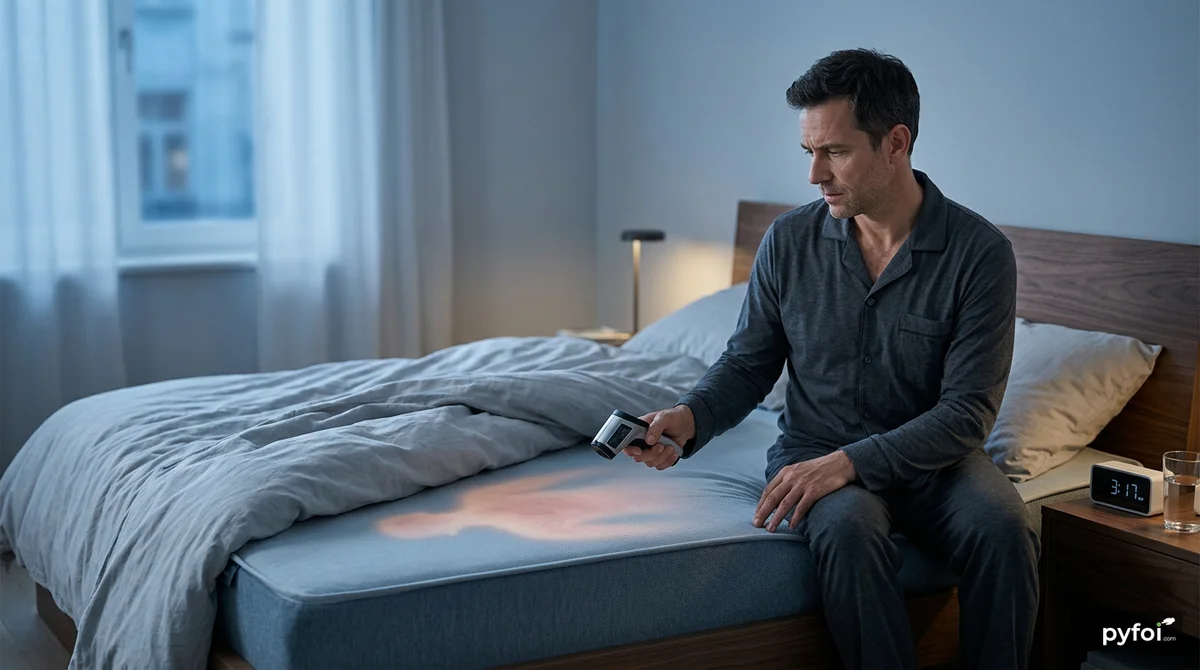

The Silent Deep Sleep Tax Your Mattress Is Costing You
Your mattress traps enough body heat to silently destroy deep sleep, costing you 146 hours of rest per year and compounding serious long-term health risks.
Here is a question worth losing sleep over, except you already are. What if you are getting eight hours in bed but only five hours of actual rest? Not because of stress or caffeine, but because your mattress is quietly dismantling the most valuable phase of your entire night.
Why Eight Hours Might Only Be Worth Five
Most mattress shoppers fixate on firmness, comfort layers, and brand reputation. Fair enough. But sleep science has moved well past those surface-level factors. The single biggest predictor of whether you wake up genuinely restored is not how long you sleep but how much deep sleep your brain manages to complete.
Here is the uncomfortable truth: a standard foam or hybrid mattress traps your body heat and builds a microclimate that directly undermines deep sleep. Auckland University testing found a traditional mattress surface hits 35 degrees Celsius within an hour [1]. You could set your bedroom to a perfect 18 degrees and still be sleeping in a 35-degree heat pocket.
So forget "is this mattress comfortable?" The questions that actually matter are: what temperature does this surface reach after an hour? Does it manage heat continuously or just briefly? And if it is disrupting my sleep, how would I ever know?
The Damage You Cannot Feel
The disruption works through micro-arousals, brief brain activations under 16 seconds that pull you out of deep sleep without ever waking you. Research published in Neuron in 2024 found that micro-arousals "stand at the crossroad between noradrenaline signaling and key sleep functions" [2]. You will never remember one. But the toll is real:

- Micro-arousals during sleep are directly associated with increased cortisol, elevated blood lipids, and higher blood pressure, the same markers linked to cardiovascular disease [3].
- Sleep fragmentation produces decreased cognitive performance, degraded mood, and altered hormone secretion, effects comparable to outright sleep deprivation [4].
- Heat exposure specifically reduces slow-wave and REM sleep while increasing wakefulness [5].
- A Gallup survey found 57% of adults report sleeping hot at least occasionally, with hot sleepers losing an average of 24 minutes per night, or 146 hours of lost sleep every year [6].
Someone experiencing 30 or more thermal micro-arousals nightly will honestly say "I slept fine." The brain fog and fatigue get blamed on work or age.
The Compound Interest Nobody Wants
Picture two paths forward. In one, your mattress surface stays below 30 degrees and your brain completes its deep sleep cycles undisturbed. During those cycles, the glymphatic system, your brain's waste clearance mechanism, flushes out amyloid-beta and tau proteins linked to Alzheimer's disease. Research published in Science established glymphatic failure as a "final common pathway to dementia" [7].
In the other version, your mattress sits at 35 degrees. Micro-arousals fragment your deep sleep night after night. The glymphatic system never finishes its job. A landmark Monash University study in JAMA Neurology followed 346 people over 17 years and found each 1% annual reduction in deep sleep for adults over 60 was associated with a 27% increased risk of dementia and a 32% increased risk of Alzheimer's specifically [8].

This compounds silently, and every night counts.
A Temperature-First Framework
Instead of testing firmness in a showroom for five minutes, evaluate mattresses through a different lens:

- Surface temperature behaviour: Does the mattress actively regulate heat through the full night, or just feel cool briefly? Gel-infused foams typically warm up within 15 minutes.
- Deep sleep evidence: Has the product been tested against polysomnographic sleep-stage data? Comfort surveys are not the same thing.
- Sustained regulation: Auckland University's testing ran for 22 hours [1]. A mattress that stays cool for one sleep cycle is not the same as one proven across a full night.
Ask the retailer: "What temperature does this surface reach after an hour?" If they cannot answer, that tells you something.
Putting This Into Practice
Start with your own experience. If you regularly wake tired despite a full night, or if you sleep hot, your mattress surface deserves scrutiny.
For hot sleepers and anyone over 40: Look for mattresses with phase-change materials that absorb and release body heat continuously. Cooler sleep surfaces increased deep sleep by 16% in one trial [9], added 7.5 minutes per night in a multi-centre replication of 72 subjects [10], and delivered a 22% deep sleep increase alongside a 25% REM improvement in a third study [11].

For couples: One partner almost always runs hotter. Built-in temperature regulation helps both sleepers without separate solutions.
For budget-conscious buyers: Factor in the hidden costs of fragmented sleep. Supplements, sleep apps, GP visits, and lost productivity stack up when the root cause is the surface you lie on every night.
Do not rely on the showroom touch test. A mattress that feels cool under your hand for two minutes may behave completely differently at 2am after hours of radiated body heat.
The real question is not whether your mattress feels comfortable. It is whether it gives your brain the thermal conditions needed for the repair work sleep exists to deliver. For most people, on most mattresses, the honest answer is no. And until now, they have never had a reason to ask.
You may also be interested in these independent articles
Sources
- [1]Auckland University / Sleepyhead NZ / NZ Herald
- [2]Microarousals and Sleep Functions - Neuron, 2024
- [3]Microarousals, Lipids, Cortisol, and Blood Pressure - PubMed, 2004
- [4]Sleep Fragmentation Effects - JCSM, 2007
- [5]Effects of thermal environment on sleep and circadian rhythm - PMC, 2012
- [6]Sleep Temperature Linked to Overall Sleep Quality, Wellbeing - Gallup, 2023
- [7]Glymphatic failure as a final common pathway to dementia - Science, 2021 / PMC
- [8]Improving deep sleep may prevent dementia - Monash University / Framingham / JAMA Neurology, 2023
- [9]Sleep on a high heat capacity mattress increases conductive body heat loss and slow wave sleep - Raymann et al., PubMed, 2017
- [10]Enhanced conductive body heat loss during sleep increases slow-wave sleep and calms the heart - Harding et al., Scientific Reports, 2024
- [11]Sleeping for One Week on a Temperature-Controlled Mattress Cover Improves Sleep and Cardiovascular Recovery - PMC/Bioengineering, 2024
© 2026 pyfoi. All rights reserved.