
Your Mattress Is Giving Your Heart a Night Shift
Your mattress may force your heart to work harder all night long. Research shows heat-trapping surfaces suppress HRV and block cardiac recovery in sleep.
You watch what you eat. You exercise. Maybe you wear a fitness tracker and check your resting heart rate each morning. But here's something most people never consider: your mattress might be forcing your heart to work harder all night, every night, and you'd never feel it happening.
We think about heart health in terms of diet, stress, and movement. Almost nobody thinks about the surface temperature underneath them as a cardiac variable. But the research says it is one - and it's been hiding in plain sight.
Why does your mattress matter to your heart?
When you lie on a foam mattress, body heat builds at the surface. Your body needs to cool itself, so your cardiovascular system steps in. Blood vessels dilate. Heart rate increases. Blood gets pumped to the skin surface, especially across your back where mattress contact is greatest.
That response is driven by your sympathetic nervous system - the same "fight or flight" system that fires during stress. During sleep, the opposite should happen. Your parasympathetic "rest and repair" system should take over. Heart rate should drop. Heart rate variability (HRV) should climb.

A hot mattress flips that script. Instead of recovery, you get sustained cardiovascular effort for seven or eight hours straight. Not enough to wake you, but enough to suppress the recovery window your heart depends on.
Rather than asking "is this mattress comfortable?", try asking:
- What temperature does this mattress surface reach under my body after an hour?
- Is my mattress actively managing heat, or just trapping it?
- Could my sleep surface explain the low HRV scores I keep seeing on my wearable?
What the research actually shows
The evidence linking mattress temperature to cardiac strain is building fast:
- A 2024 study of 54 subjects (Bioengineering) found that cooler mattress temperatures produced significantly larger decreases in heart rate during the first half of the night. The same study recorded 14 extra minutes of deep sleep and 9 extra minutes of REM sleep [1].
- Research in Scientific Reports (2024) confirmed that enhanced body heat loss during sleep "increases slow-wave sleep and calms the heart" [2].
- A 2025 systematic review (Frontiers in Neurology) found that chronic sleep disruption alters beta-1 adrenergic receptor density in the heart and reduces vagal acetylcholine release, increasing arrhythmia risk [3].
- Bedroom temperatures above 24 degrees Celsius have been linked to elevated cardiac stress markers [4], and heart rate during sleep follows the circadian curve of body temperature - meaning a hot mattress surface directly elevates overnight heart rate [5].

Add it up: your heart works harder than necessary for 2,500 to 3,000 hours each year. Over a ten-year mattress lifespan, that's 20,000 to 30,000 hours of elevated cardiac load during the window that should be protecting your heart.
What this costs you beyond the numbers
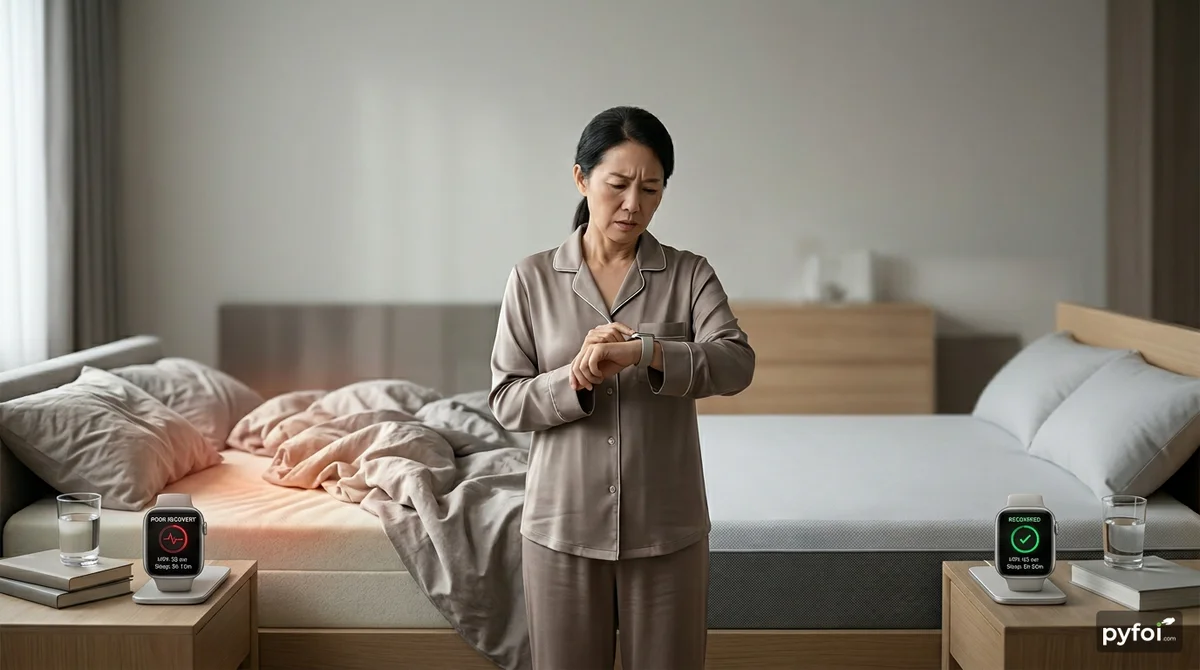
Imagine checking your wearable on a Monday morning. HRV is low again. Recovery score: poor. You slept seven and a half hours, went to bed early, skipped the wine. You blame stress and push through.
Now picture the same Monday, same routine, but on a surface that holds around 29 degrees rather than 35. Your body didn't spend the night thermoregulating. Your parasympathetic system took over. Heart rate dipped naturally. HRV climbed. Recovery score sits in the green.
The difference isn't how long you slept. It's what your heart had to do while you were sleeping. Every run, every meal plan, every stress-management strategy gets quietly undermined if your mattress puts your heart to work for eight hours straight.
A temperature-first approach to your next mattress
Flip the usual decision framework. Before firmness, before brand, ask these questions:

- Does it regulate surface temperature? Not just "breathability" in the marketing copy, but an actual mechanism that controls heat at the contact layer.
- Can I measure the effect? If you use a wearable, your overnight heart rate and HRV will show the difference within a week.
- What's the compounding cost of ignoring this? A hot mattress isn't just uncomfortable. It accumulates cardiovascular strain across thousands of hours.
How to choose with your heart in mind
Temperature regulation isn't a luxury feature. For anyone with cardiovascular risk factors, a family history of heart disease, or a genuine interest in recovery data, it belongs alongside support and comfort as a core criterion.
When you shop, look for mattresses with phase-change or active cooling technologies that hold the surface closer to 29 degrees rather than letting it climb into the mid-thirties. Ask the retailer what the measured surface temperature is under load - not whether the mattress "sleeps cool." Gel layers and ventilation holes aren't the same as engineered temperature control.
If you own a wearable, use it as your testing tool. Track your overnight heart rate and HRV for a week on your current mattress, then trial a temperature-regulating option. The data removes the guesswork.
For couples, body heat output varies. A mattress that works for one partner may still run hot for the other. Look for options that manage temperature across the full surface.
Your mattress lasts eight to ten years. That's tens of thousands of hours your heart spends either recovering or working overtime. Make sure your sleep surface isn't quietly cancelling every other health investment you make.
You may also be interested in these independent articles
Sources
- [1]Sleeping for One Week on a Temperature-Controlled Mattress Cover Improves Sleep and Cardiovascular Recovery - Bioengineering, 2024
- [2]Enhanced conductive body heat loss during sleep increases slow-wave sleep and calms the heart - Scientific Reports, 2024, Nature
- [3]Effects of sleep deprivation on heart rate variability - systematic review - Frontiers in Neurology, 2025
- [4]Is the temperature of your bedroom hurting your heart? - The Hill, citing cardiology research
- [5]Heart rate during sleep follows circadian curve of body temperature - PMC4263095
© 2026 pyfoi. All rights reserved.